Siege Perilous
Le Morte d'ArthurThe Siege Perilous is the reserved seat at the Round Table whose fulfillment marks the arrival of the knight destined to achieve the Sangreal. Its place in the court joins Arthurian custom to Christian sacred history: the seat is not merely vacant, but held for a moment appointed by prophecy and ultimately connected to the Grail’s revelation.
The Grail and its Christian history
The Sangreal, or Holy Grail, is central to Malory’s book. The word “Grail” could mean a dish, a drinking vessel, or a tureen; romances described it both as a shallow dish for food and as a cup. The introductory account traces the legend to older stories of a vessel that miraculously supplied food, but explains that its Christian form gave it a specific sacred history.
In the romances discussed in the account, the Grail is the dish that held the paschal lamb at the Last Supper. Joseph of Arimathea took it away and received Christ’s blood in it; he then brought the vessel, with part of that blood, to England, where it served in the conversion of heathens and was kept at Corbenicy. The same tradition therefore gives the Grail a material history, a Christian meaning, and a place in Britain’s sacred past.
At the Pentecost feast that sets the Quest in motion, the Grail passes through Arthur’s hall covered with white samite, though no one can see who bears it. Its passage fills the hall with good odors and provides each knight with the food and drink he most desires, before the vessel suddenly departs. This episode recalls the older image of the miraculous food-giving vessel while placing it within the court’s Christian wonder.
The seat and its appointed time
The chapters introducing the Grail quest make the Siege Perilous part of a sequence of signs. Their headings describe letters discovered on the seat, an old man bringing Galahad to it and setting him there, and Arthur showing Galahad a sword fixed in a stone floating on the water. The seat’s significance thus rests not simply on its reservation, but on the revelation that it is to be occupied by the knight connected with the Grail’s achievement.
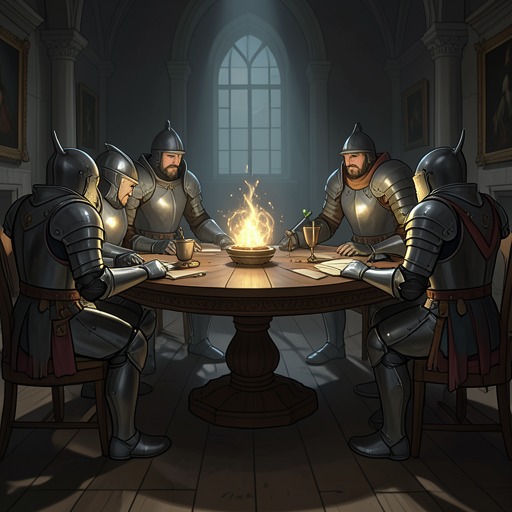
The text gives a precise sacred chronology to the seat’s fulfillment. On Whitsunday at Camelot, after Sir Bors and Sir Lionel return to court, the knights find golden writing placed around the Round Table. At the Siege Perilous, newly written letters declare that the seat should be fulfilled 454 years after the Passion of Christ. Sir Launcelot calculates that the appointed day has arrived, and proposes covering the inscription until the knight destined to achieve the adventure comes. The court covers the letters with silk; the prophecy is disclosed, but the seat’s fulfillment remains to be witnessed.
Fulfillment within the Round Table fellowship
The Siege Perilous belongs to a court governed by meaningful ritual. On the same Whitsunday, Sir Kay reminds Arthur that the court’s custom is not to sit down to meat before an adventure has been seen. Arthur admits that his joy at Sir Launcelot and his cousins’ safe return had distracted him from the practice. The floating stone and sword then provide the marvel the company awaits. In this setting, the reserved seat is one element in a wider pattern of Pentecost signs, ceremonial expectation, and encounters that direct the knights toward the Grail.
The introductory account also describes the Grail’s later appearance at a silver table before Joseph, identified as the first bishop of Christendom, and four angels. In the episode, heavenly attendants bring a bleeding spear and candles, and Joseph performs the mass before Christ appears from the vessel and gives communion to Galahad and his companions. The seat’s fulfillment and Galahad’s Grail role therefore belong to a narrative in which the Round Table’s worldly fellowship is tested and given meaning through Christian revelation.
Significance
As an object, the Siege Perilous is both a place within Arthur’s court and a sign of a sacred appointment. Its golden inscription anchors the adventure in a measured Christian chronology; the silk covering temporarily withholds the announced fulfillment, while the gathering at Camelot turns that revelation into a public event. The reserved seat makes the Grail quest legible before its completion: the court can recognize that an appointed place exists, even as the prophecy must await the knight who will occupy it.